

Operational principle
There is no universal 30, 60, 90, or 180-day definition for dead stock across all retail categories. Every business must establish meaningful observation windows based on product shelf life, lead times, and normal sales velocity.
Short answer: slow-moving inventory vs dead stock
While both conditions involve sluggish merchandise, their operational trajectory and required interventions are fundamentally distinct:
Slow-Moving Inventory
Slow-moving inventory: Merchandise that continues to sell, but at a velocity lower than the store's desired target or historical average. It generates revenue and customer interest, but ties up working capital longer than planned.
Dead Stock
Dead stock: Inventory that has completely stopped selling and has no realistic expectation of moving under normal retail merchandising without aggressive operational intervention.
Critical operational note: There is no universal 30, 60, 90, or 180-day rule for dead stock. For a high-traffic convenience store, 60 days without a sale on a snack item indicates dead stock. For an upscale specialty boutique selling hand-crafted ceramic vases, 120 days between sales may be completely expected. Retailers must establish category-specific observation windows.
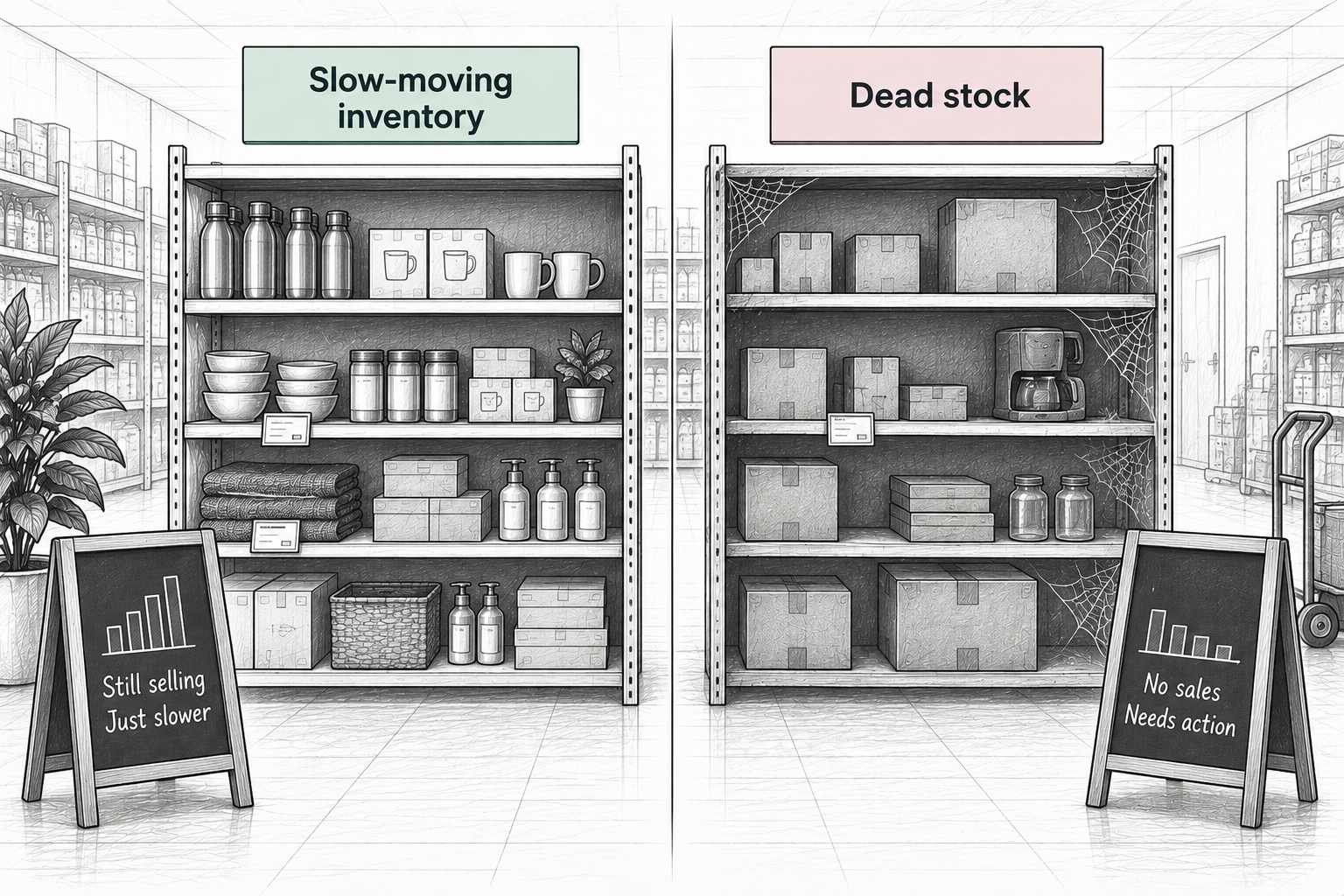
Comparison table: slow-moving inventory vs dead stock
Compare the key operational differences between slow-moving items and dead inventory:
| Operational Dimension | Slow-Moving Inventory | Dead Stock |
|---|---|---|
| Sales activity | Generates intermittent sales; customer demand exists but volume is low. | Zero sales over the defined observation window; demand has effectively ceased. |
| Action urgency | Moderate; review reorder quantities, adjust merchandising, or bundle. | Immediate; mark down, bundle, return to supplier, liquidate, or write off. |
| Shelf-space impact | Occupies active space with low yield per square foot. | Blocks valuable shelf and backroom space needed for profitable inventory. |
| Cash-flow impact | Gradually returns capital into the business, albeit at a sluggish rate. | Completely traps working capital in non-productive inventory assets. |
| Replenishment decision | Reduce reorder frequency, order smaller pack sizes, or lower safety stock. | Halt all replenishment immediately and flag SKU in catalog records. |
| Price strategy | Minor promotional discounts, feature displays, or cross-merchandising. | Aggressive clearance pricing, deep discounts, or liquidation to recover cash. |
Dead stock is not always old stock
Retail managers often assume that dead stock is simply merchandise that has sat in the backroom for years. In reality, newly received merchandise can become dead stock almost immediately:
Sudden viral trend collapse:
A novelty toy, trendy snack, or viral fashion accessory experiences a sudden spike in demand, but customer interest evaporates overnight.
Immediate product obsolescence:
Phone cases, tech accessories, or device chargers become unsellable the day a manufacturer redesigns connector ports or device dimensions.
Packaging and formulation changes:
When a manufacturer releases a new packaging design or improved formula, remaining units in older boxes often sit untouched on the shelf.
Past-holiday seasonal inventory:
Holiday-themed chocolates, decor, or seasonal gift baskets become dead stock the day following the holiday, regardless of how recently they were received.
Slow-moving inventory does not always mean bad stock
It is important to recognize that some merchandise is intentionally designed to sell slowly while fulfilling an important strategic role in your store assortment:
High-margin specialty wines & spirits:
A $90 bottle of vintage wine may only sell twice a year, but its high gross margin and premium prestige justify its shelf presence.
Specialist retail tools & hardware:
A specialized pipe cutter or rare plumbing fitting sells infrequently, but keeps professional contractors returning to your local hardware store.
Premium skincare & luxury cosmetics:
Luxury beauty lines serve as flagship anchor products that elevate customer perception across the entire beauty section.
Seasonal outdoor decor & equipment:
Camping stoves, snow shovels, and garden tools turn slowly during shoulder months, but generate reliable demand during specific weather events.
What causes dead stock in small retail stores?
Dead stock rarely occurs through bad luck alone. It is almost always the consequence of identifiable operational decisions:
Over-ordering driven by vendor volume discounts:
Buying 20 cases of an unproven product to receive free freight or a 10% invoice discount, only to sell 2 cases over six months.
Distributor minimum order quantities (MOQs):
Distributors requiring full master cartons on slow-selling specialty items when the store only needed three units.
Inaccurate demand forecasting & guesswork:
Ordering based on subjective employee enthusiasm or vendor sales pitches rather than verifiable point-of-sale sales data.
Post-holiday seasonal carryover:
Ordering excessive quantities of holiday merchandise that arrives too close to the holiday to sell out completely.
Duplicate SKUs & brand overlap:
Carrying five different brands of gluten-free pasta that split customer demand into negligible fractions.
Poor sales floor visibility & buried stock:
Items relegated to bottom shelves, dark corners, or forgotten in backroom reserve boxes without active shelf facings.
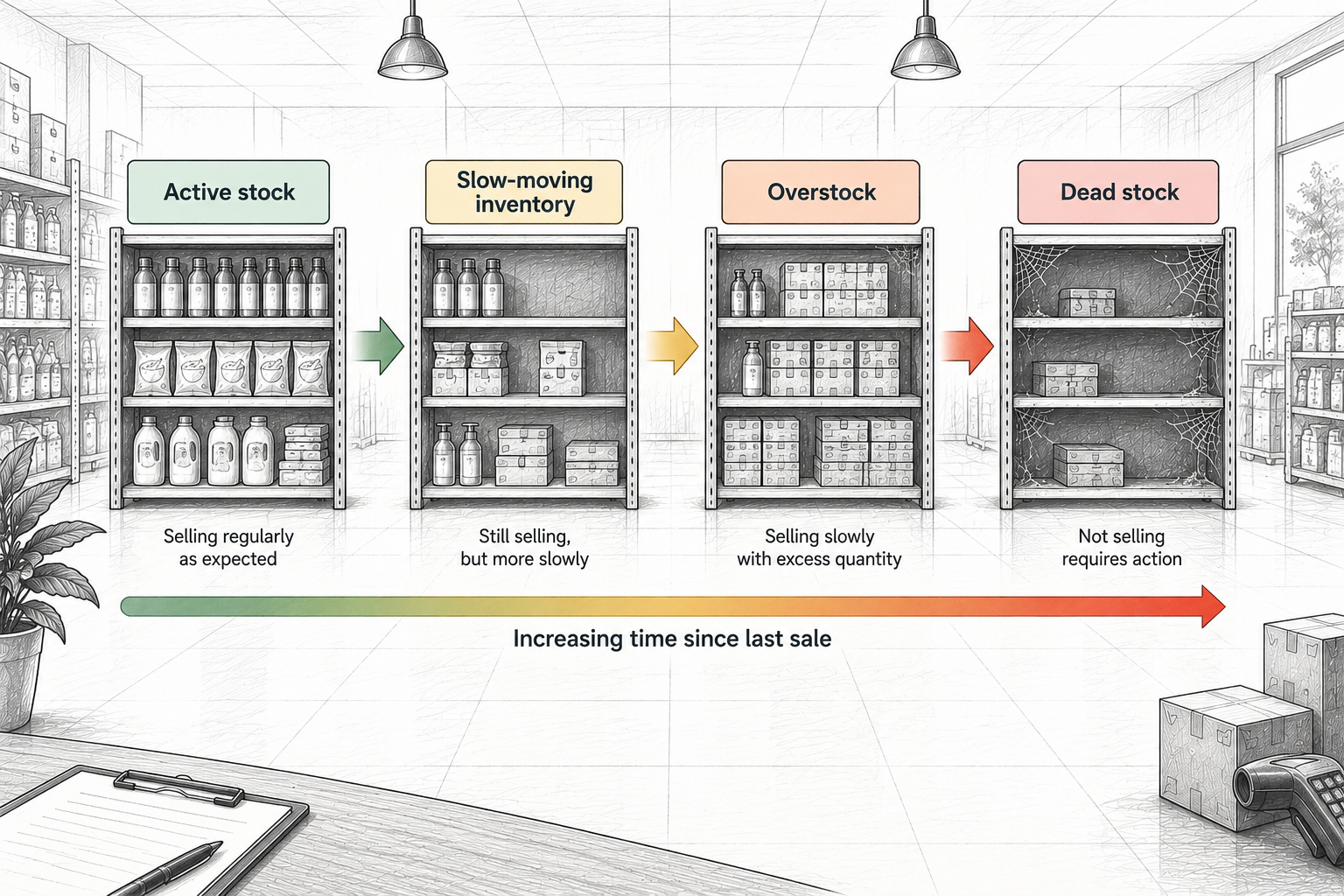
How to identify slow-moving inventory
Monitoring operational signals helps store managers catch sluggish inventory before it completely freezes into dead stock:
Days since last recorded sale:
Filter sales reports to identify items with zero customer transactions over the past 30 to 45 days.
Ratio of stock on hand to recent sales velocity:
If a shelf holds 40 units and sales average 1 unit per month, the store is carrying over three years of supply.
Repeated reordering despite existing shelf stock:
Uncoordinated purchasing orders placed while identical merchandise sits unworked in backroom cartons.
Underperformance against category averages:
Comparing an item's velocity against the median turnover speed of direct category peers.
How to identify dead stock with a store policy
Because there is no universal industry timetable, small retailers must define explicit internal criteria for dead stock review:
Dead stock vs overstock: understanding the distinction
Retailers often use the terms overstock and dead stock interchangeably, but they represent different inventory states:
Overstock:
Having more inventory on hand than current customer demand requires over a normal reorder cycle.
Overstock still sells steadily, but excess units consume cash and shelf capacity. If left unaddressed, overstock can eventually deteriorate into dead stock.
Dead stock:
Merchandise that has completely ceased moving and generates zero regular sales.
Dead stock requires active intervention (markdown, clearance, or write-off) because normal shelf merchandising will not sell it.
Dead stock vs shrinkage: physical presence vs book loss
It is essential not to confuse dead stock with retail inventory shrinkage:
Dead stock:
Physical state: The merchandise physically exists on your shelves or backroom racks.
Accounting state: Recorded on your books and present on the floor, but generating zero revenue.
Inventory shrinkage:
Physical state: The merchandise is physically missing from the store.
Accounting state: Recorded in computer inventory records but lost to shoplifting, employee theft, cashier mis-scans, or unrecorded damage.
What dead stock actually costs a small business
Dead stock imposes serious operational costs that erode small business profitability:
Trapped working capital:
Every dollar tied up in unsold cartons on a backroom shelf is cash that cannot be used to pay invoices, cover payroll, or purchase bestsellers.
Lost sales floor space (opportunity cost):
Dead items occupy prime eye-level shelf space that could otherwise generate high-margin daily sales with fast-moving products.
Backroom storage congestion:
Cluttered storage racks make receiving and physical stocktakes slower and more prone to counting mistakes.
Obsolescence and expiration damage:
The longer products linger, the higher the likelihood of past-date expiration, crushed cartons, packaging fading, and total write-off.
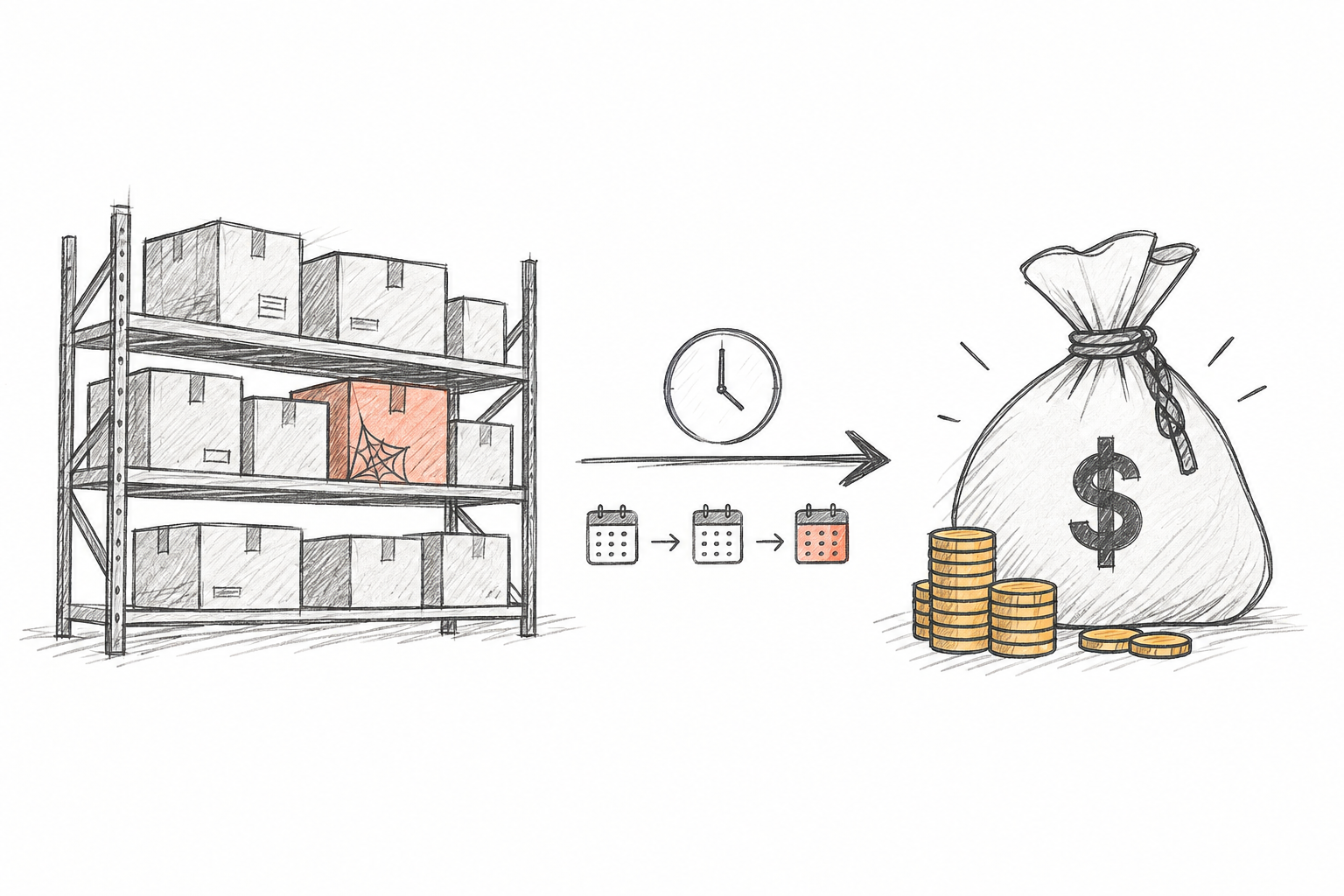
While corporate logistics textbooks often cite rigid carrying-cost percentages, true holding costs for small retail are qualitative: lost cash liquidity, physical storage congestion, and markdown pressure.
What to do with slow-moving inventory
Slow-moving inventory still possesses active customer demand. Apply operational adjustments to accelerate sales velocity before considering drastic markdowns:
Pause or reduce supplier reordering:
Halt all new purchase orders for the item until on-hand stock naturally depletes to healthy baseline levels.
Reposition product on the sales floor:
Move the merchandise from bottom shelves to high-traffic endcaps, eye-level shelf tiers, or checkout impulse racks.
Bundle with complementary bestsellers:
Pair slow-moving artisan crackers with popular cheese wedges at an attractive combination price.
Run modest promotional discounts:
Offer a 10% to 15% discount or 'buy two, get one at 25% off' incentive to encourage customer trial.
Engage staff in customer recommendations:
Ensure floor staff are familiar with the product's features so they can recommend it genuinely to shoppers.
What to do with dead stock: actionable recovery options
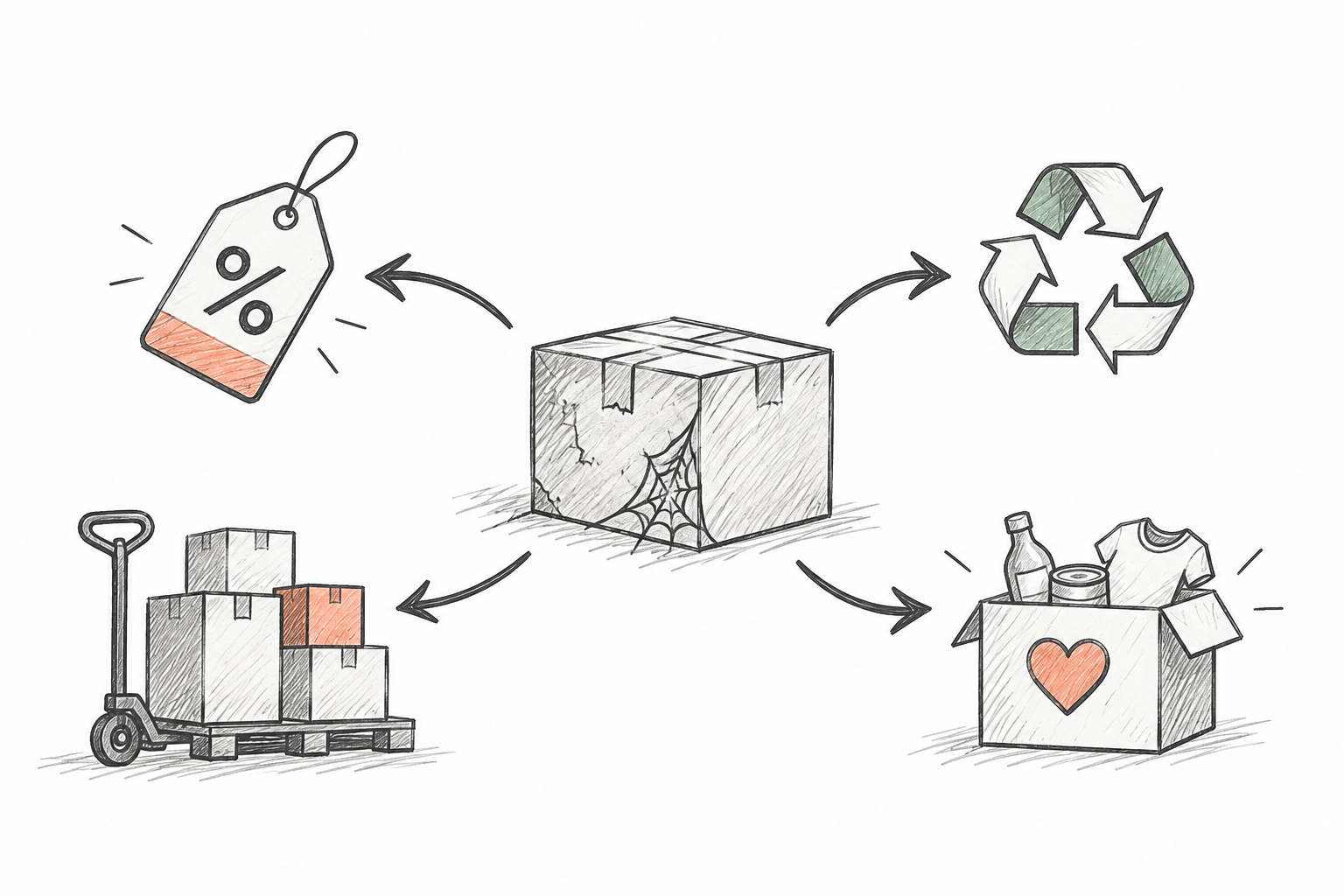
When inventory has completely stopped moving, the goal shifts from maximizing profit to recovering cash and reclaiming shelf space:
Disciplined clearance markdowns:
Slash prices by 30%, 50%, or more in a designated, well-signed clearance section to convert dead items back into cash.
Supplier returns or exchange credits:
Contact your distributor sales rep to ask if unopened master cases can be returned or exchanged for faster-moving goods.
Transfer to another store location:
If operating multiple shops, transfer the stock to a location with customer demographics that match the product.
Charitable donation where appropriate:
Donate non-perishable pantry items, hygiene goods, or apparel to local community charities where permitted.
Formal write-off and disposal:
If merchandise is broken, expired, or unsellable, formally document the write-off and dispose of the goods responsibly.
How to prevent future dead stock
Proactive purchasing discipline is the most effective defense against recurring dead stock:
Order sample batches or minimum pack quantities first to verify real consumer demand before committing to bulk purchases.
Verify whether pending distributor deliveries are already en route before placing duplicate orders.
Evaluate whether the holding cost of slow-turning cartons outweighs the superficial 5% invoice savings.
Frequent cycle counts ensure stock records remain accurate so you never order products already hidden in the backroom.
Establish clear cut-off dates for seasonal ordering so unneeded holiday stock does not linger into the following season.
How Retail Scan & Stock supports inventory health
Retail Scan & Stock provides the foundational shop floor tools small retailers need to keep inventory accurate and transparent:
Barcode-backed physical stock counts:
Scan product barcodes on your phone to verify actual quantities on hand across shelves and storage rooms.
Clear write-off and adjustment documents:
Record damaged, expired, or liquidated items in structured adjustment documents for transparent bookkeeping.
Structured purchase order drafting:
Create clean orders linked to verified floor counts to avoid duplicate ordering and bloated inventory levels.
Excel and CSV spreadsheet exports:
Export count and order records directly to standard spreadsheets for easy sharing with accountants and distributors.
Retail Scan & Stock provides barcode-backed physical counts, write-off documentation, and spreadsheet exports; it does not feature automated dead-stock detection algorithms, sales analytics, or predictive AI markdown recommendations.
Frequently Asked Questions
How many days without a sale officially makes inventory 'dead stock'?▾
There is no universal number of days. High-turnover convenience stores often classify everyday snacks without sales for 60 to 90 days as dead stock. Specialty boutiques, hardware stores, or luxury gift shops may consider 180 to 270 days completely normal. Every store must define observation windows by category.
Can slow-moving inventory become dead stock over time?▾
Yes. If demand continues to decline, packaging deteriorates, or new product versions render older stock obsolete, slow-moving items frequently transition into permanent dead stock if managers fail to take corrective action.
What is the best way to price clearance merchandise to recover cash?▾
Start with an initial markdown (such as 25% to 30% off) in a visible clearance section. If items remain unsold after two weeks, deepen the discount to 50% or offer bundling incentives (such as buy-one-get-one). The primary objective is to recover working capital and reclaim shelf space.
Can I return dead stock to my wholesale supplier?▾
Return policies vary widely among distributors. Some suppliers allow returns on unopened master cartons subject to a restocking fee (typically 10% to 20%), while others do not accept returns on non-defective goods. Contact your supplier sales representative to discuss exchange options.
How do I account for dead stock write-offs on business tax filings?▾
Writing off unsellable inventory removes the asset value from your balance sheet and reflects the loss in your Cost of Goods Sold. However, specific documentation requirements and tax deduction rules vary by jurisdiction. Always confirm proper accounting treatment with your accountant or tax professional.
Does Retail Scan & Stock automatically notify me when an item becomes dead stock?▾
No. Retail Scan & Stock provides mobile barcode scanning, physical stocktaking sessions, and spreadsheet exports so you have accurate physical data. Identifying dead stock requires comparing your physical records and sales reports against your store's observation policies.
Related retail guides and tools
- → Inventory Carrying Cost: What Unsold Stock Really Costs a Small Retailer
- → Inventory Turnover Ratio: A Simple Guide for Small Retail Stores
- → Inventory Shrinkage: What It Is, What Causes It, and How Small Stores Can Reduce It
- → Reorder Point vs Par Level vs Safety Stock: A Simple Guide for Small Retailers
- → From Stock Count to Purchase Order: A Simple Reordering Workflow for Small Stores