
Core buying rule
An MOQ is a supplier-side commercial boundary, not an inventory optimization formula. A lower unit purchase price is only an economic advantage if your store can realistically sell through the stock before shelf life expires, customer interest cools, or carrying costs consume the upfront discount.
What MOQ means in plain language
A Minimum Order Quantity (MOQ) is the lowest quantity of a product, master carton count, or total monetary order value that a distributor or manufacturer is willing to sell in a single order under specific commercial terms:
Unit-based MOQ
The supplier requires purchasing a minimum number of individual pieces (e.g., minimum 48 bottles of organic hot sauce).
Case-pack or master-carton MOQ
The supplier will not break outer shipping cartons; orders must be placed in multiples of master packs (e.g., 12 units per inner pack, 4 inner packs per case = 48 units minimum).
Monetary order minimum
The vendor sets a minimum total dollar amount per purchase order or delivery run (e.g., $300 minimum order to qualify for delivery or wholesale terms).
Supplier economics vs small-store retail economics
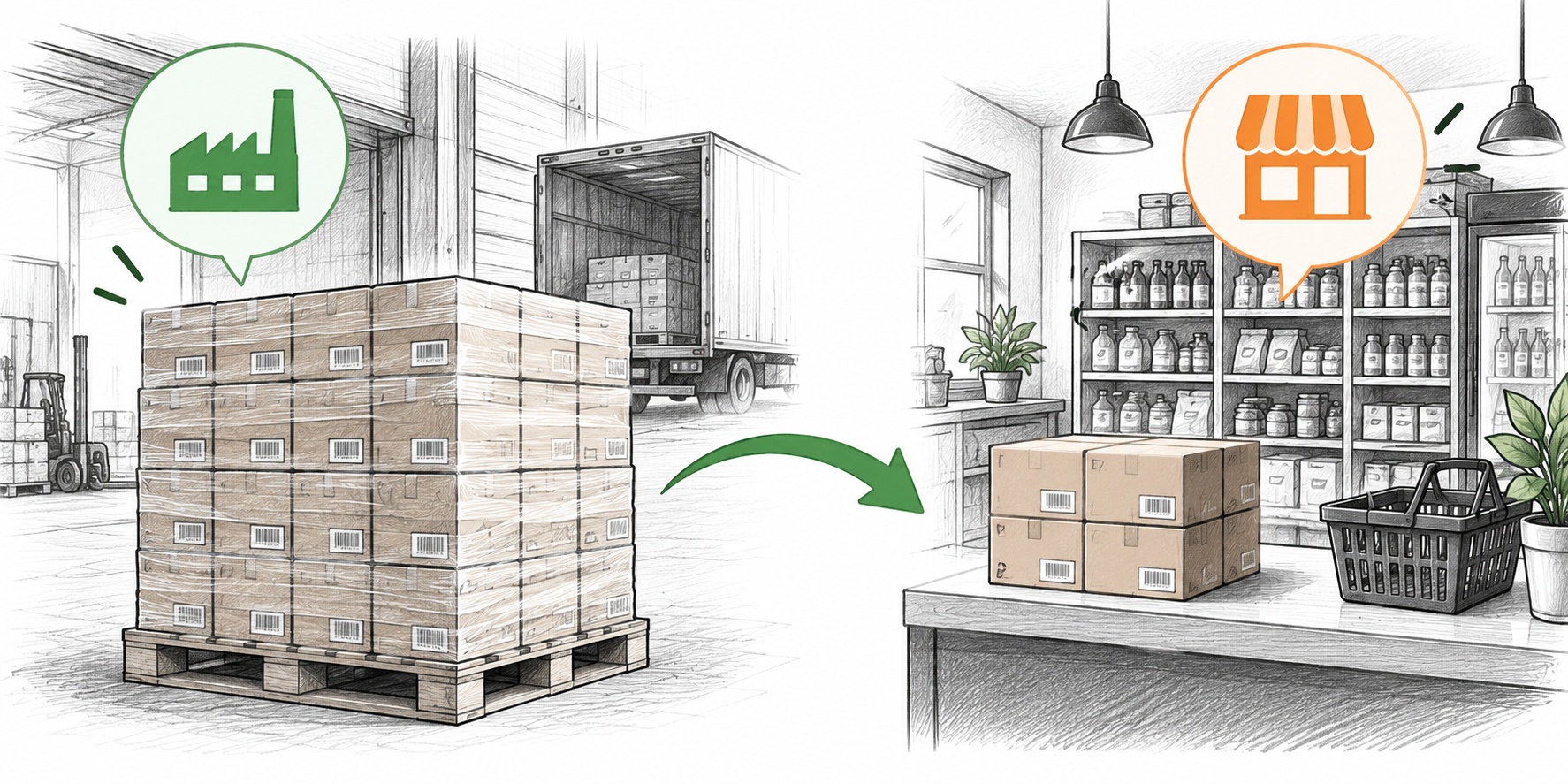
MOQs exist because distributors and factories face fixed transaction and logistics overhead. Recognizing why suppliers impose minimums helps retailers negotiate effectively:
Packaging and warehouse labor
Supplier perspective: Breaking open master cartons to pick three individual bottles takes warehouse staff the same time as moving an entire 24-unit case.
Retailer perspective: Receiving single units matches small backrooms, but loose picking creates extra packaging handling fees from distributors.
Freight and pallet transport efficiency
Supplier perspective: Dispatching half-empty delivery vans or paying third-party courier minimums burns distributor operating margins.
Retailer perspective: Ordering small weekly drops keeps cash flowing, but distributors prefer drops with substantial order values.
Manufacturing production runs
Supplier perspective: Calibrating machinery for specialty products requires minimum batch sizes to justify factory setup downtime.
Retailer perspective: Small shops only need test quantities to determine whether a brand appeals to local neighborhood foot traffic.
Why a lower wholesale unit cost is not automatically cheaper
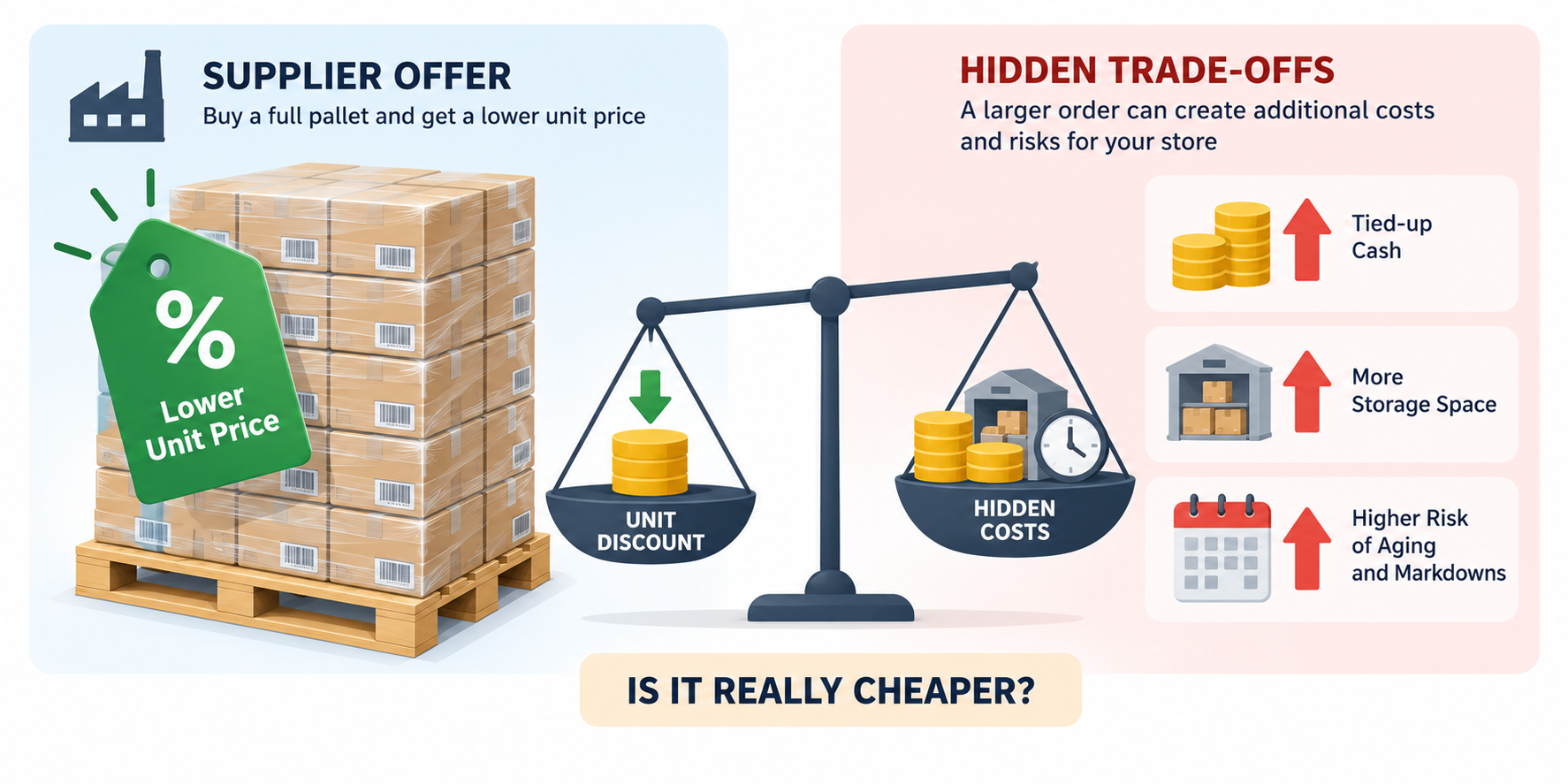
Wholesale tier discounts tempt buyers with lower unit prices on large orders. But factoring in total inventory holding consequences often reverses the math:
Tied-up working capital
Committing $1,200 to purchase a 6-month supply of one SKU leaves less cash available to restock proven everyday sellers.
Creates temporary cash pinches that prevent paying suppliers on time or restocking high-turnover staples.
Physical storage and shelf crowding
Bulky cases stack up in cramped backrooms, blocking access to other merchandise and increasing carton handling damage.
Forces additional handling labor and risks stock damage before products ever make it onto the sales floor.
Markdown and obsolescence exposure
Consumer tastes shift, packaging designs update, or seasonal weather turns, leaving unsold units stranded.
Discounting remaining inventory at 40% to 50% off to clear shelves completely wipes out the original volume discount.
Estimating your store demand window before accepting an MOQ
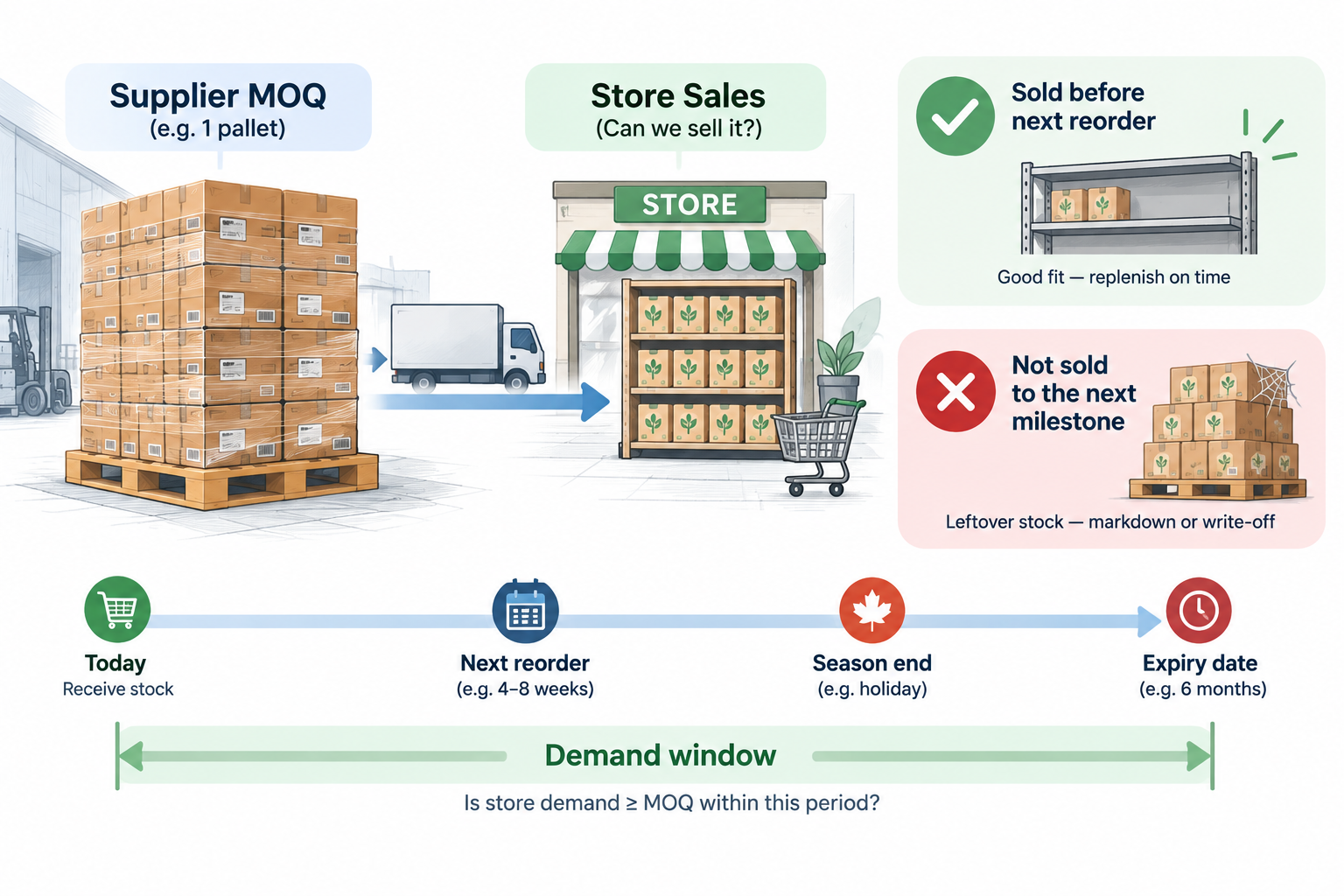
Before agreeing to a supplier's minimum quantity, calculate how many weeks or months of forward supply that order represents relative to key operational deadlines:
1. Next routine reorder cycle
If your normal reordering cadence from this distributor is weekly or bi-weekly, an MOQ that represents 12 weeks of stock drastically over-commits your working capital.
Freezes replenishment flexibility while you wait for customer demand to slowly digest the large batch.
2. End-of-season or holiday cutoff
For seasonal apparel, beach accessories, or holiday confectionery, sales velocity drops to near zero once the key holiday date passes.
Unsold units immediately become dead stock requiring steep clearance discounting.
3. Expiry, freshness, or obsolescence horizon
For non-perishable goods, look at packaging revisions, formula updates, or style changes. For perishables, track manufacturer 'best before' dating strictly.
Expired food or outdated models must be written off entirely as a direct financial loss.
A simple worked retail MOQ evaluation example
Consider an independent specialty gift and kitchenware store evaluating a supplier's wholesale tiered pricing for a popular artisanal scented soy candle:
| Decision Factor | Large Bulk Order | Lean Replenishment |
|---|---|---|
| Order Quantity Option | Bulk Tier: 120 units (Supplier Volume MOQ) | Standard Tier: 24 units (Standard Case Pack) |
| Wholesale Price per Unit | $10.00 per unit ($1,200 total invoice) | $12.00 per unit ($288 total invoice) |
| Store Sales Velocity | 4 units sold per week | 4 units sold per week |
| Time Required to Sell Through | 30 weeks (approx. 7.5 months of inventory) | 6 weeks (approx. 1.5 months of inventory) |
| Working Capital Committed Upfront | $1,200 tied up for over half a year | $288 committed; restocked as needed |
| Estimated Holding & Shrink Risk | Approx. 20% annual carrying cost rate on $600 avg stock ≈ $70+ holding cost, plus risk of scent fading or label scuffs over 7 months | Negligible holding cost; fresh candle stock turns continuously with zero packaging deterioration |
While the 120-unit bulk tier saves $2.00 per candle on invoice price ($240 theoretical savings), it locks up an additional $912 in working capital for seven months. If holiday foot traffic dips or customers shift toward other fragrances, the store faces clearance markdowns that easily erase the margin gain. For a small merchant with limited cash reserves, buying the smaller 24-unit pack is often the far safer operational choice.
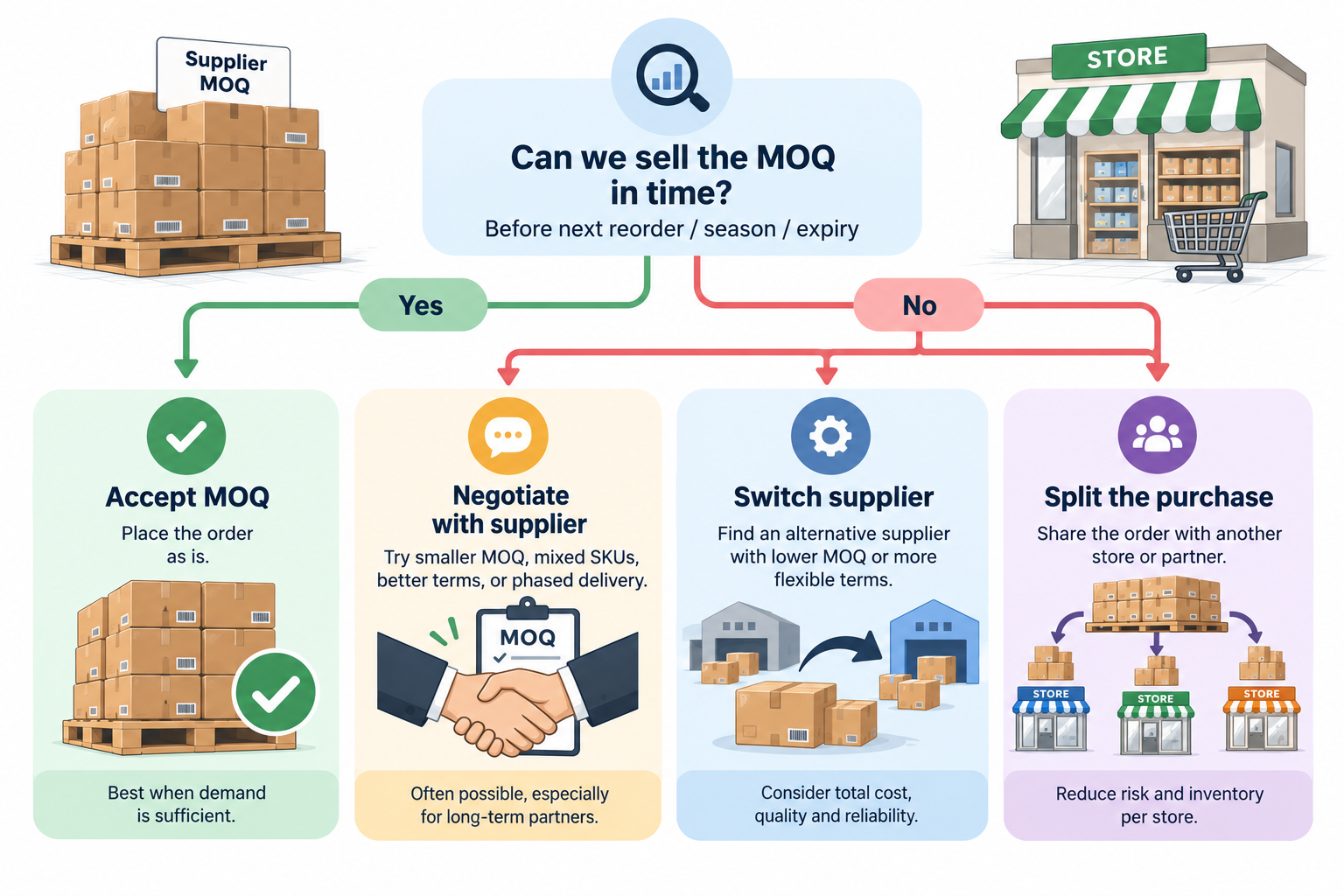
When accepting the MOQ makes sense vs when to negotiate or switch
Large orders are not inherently bad. Under the right conditions, accepting an MOQ makes strong business sense:
Accept the supplier MOQ
The product is a proven, non-perishable core seller with steady demand, and the order coverage aligns with your store's normal reorder cadence, shelf life, and storage capacity without straining working capital.
Verify that your cash flow can handle the invoice without postponing payments to other essential vendors.
Negotiate with the supplier
You have an established payment track record with the vendor. Request mixed-case ordering (e.g., 24 units total combining four different fragrances or sizes) or ask for a modest surcharge to break the master case.
Suppliers cannot always accommodate split cartons, but sales representatives will often support established retail partners.
Find an alternative distributor or source
The manufacturer's direct MOQ is completely unfeasible (e.g. 500 units), but secondary wholesale distributors or cash-and-carry suppliers carry the item in smaller inner-pack quantities at a slightly higher wholesale unit cost.
Paying 10% more per unit to buy 12 pieces instead of 200 preserves your working capital and avoids holding risk.
Pool or split purchases with peer retailers
Friendly non-competing merchants in adjacent neighborhoods split a master pallet or high-volume wholesale order to access tier discounts without individual overstocking.
Ensure billing, transport arrangements, and delivery receiving responsibilities are clear and practical.
MOQ vs EOQ: distinguishing commercial constraints from theoretical models
Retail textbooks frequently discuss Economic Order Quantity (EOQ), but store operators must distinguish textbook formulas from supplier realities:
MOQ (Minimum Order Quantity)
Supplier-side commercial constraint
An external rule set by the vendor based on their shipping, packaging, and manufacturing economics. You must either meet it, negotiate around it, or walk away.
EOQ (Economic Order Quantity)
Buyer-side mathematical model
A theoretical formula calculating the optimal order size that minimizes the sum of order placement costs and inventory holding costs.
A practical small-store MOQ decision workflow
Before signing a large supplier purchase order, run the item through this four-step evaluation sequence:
Calculate demand run-rate in weeks
Divide the supplier's MOQ by your average weekly sales velocity, and evaluate that forward supply against your store's normal reorder cadence, demand predictability, expiry limits, storage capacity, and working-capital tolerance. Trigger caution whenever the required order coverage exceeds those operational constraints.
Evaluate deadline and obsolescence risks
Check whether the quantity will fully sell before expiration dates, packaging redesigns, seasonal peaks end, or style trends fade.
Audit working capital and cash impact
Ensure committing upfront cash to this order will not compromise your ability to pay rent, payroll, or replenish everyday core winners.
Select the operational response
Choose between accepting the tier, negotiating mixed-case packs, sourcing smaller batches from a secondary distributor, or declining the product.
Where Retail Scan & Stock fits in the replenishment workflow
Evaluating supplier minimums requires accurate knowledge of current shelf counts and active vendor orders. Retail Scan & Stock supports this front-line process:
Mobile barcode stock counts
Scan current on-hand quantities with your phone camera before placing orders, so you never accidentally accept an MOQ on an item you already have in the backroom.
Vendor-specific purchase order drafts
Organize line items by supplier, monitor draft order totals against vendor minimum requirements, and export clean order documents.
Receiving delivery verification
Audit inbound supplier shipments directly against purchase orders to ensure master carton counts match invoices before signing delivery receipts.
Frequently Asked Questions
Can small retailers negotiate supplier MOQs?
Yes, especially with distributors with whom you have built a reliable payment history. Practical negotiation requests include asking for mixed-flavor case packs, offering to pay a small per-unit broken-case surcharge, or placing a larger total dollar order across multiple product lines from the same vendor.
Is buying in bulk always risky for small stores?
No. When applied to non-perishable everyday essentials with predictable demand (such as basic paper towels, staple cleaning goods, or year-round bestsellers), bulk purchasing captures valuable margin discounts with minimal inventory risk.
What should I do if a supplier raises their MOQ unexpectedly?
Recalculate your demand window. If the new MOQ pushes stock coverage past your comfortable risk threshold, explore whether regional wholesale distributors stock the product, or inform the supplier rep that the new threshold exceeds your store's storage capacity.
Does EOQ replace the need to consider MOQs?
No. EOQ is an internal mathematical calculation of your ideal order size, but real suppliers will not ship orders below their commercial minimums. If your calculated EOQ is 20 units and the supplier MOQ is 60 units, you must decide whether the operational consequences of ordering 60 units are acceptable.
How does an MOQ affect inventory carrying costs?
Accepting a high MOQ increases your average inventory investment over the selling cycle. Holding excess cartons ties up cash, absorbs storage space, and increases risks of carton scuffing, expiration, or seasonal dead stock, driving up cumulative carrying costs.
Related inventory guides and resources
- Reorder Point vs Par Level vs Safety Stock: A Simple Guide for Small Retailers →
- From Stock Count to Purchase Order: A Simple Reordering Workflow for Small Stores →
- How to Receive Inventory From Suppliers Without Creating Stock Errors →
- Inventory Carrying Cost: What Unsold Stock Really Costs a Small Retailer →
- How to Prevent Stockouts in a Small Retail Store →